Natural gas
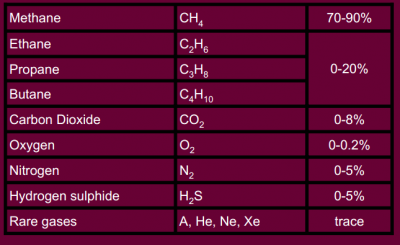

Natural gas is a hydrocarbon gas consisting primarily of methane, typically with 0–20% higher hydrocarbons[1] (primarily ethane). It is found associated with other hydrocarbons in petroleum reservoirs, in coal beds, as methane clathrates, and is an important fuel source and a major feedstock for fertilizers.
Most natural gas was created over time by two mechanisms: biogenic and thermogenic. Biogenic gas is created by methanogenic organisms in marshes, bogs, landfills, and shallow sediments. Deeper in the earth, at greater temperature and pressure, thermogenic gas is created from buried organic material.[2]
In oilfield, natural gas is present in all producing fields. Upon arrival of production fluid at processing facilities, natural gas is first separated with oil/water in separators (often with the assistance of defoamers to prevent liquid carry over) and then further processed to meet sales specifications or flared via flare stack if the amount is uneconomically small.
Before natural gas can be used as a fuel, it must undergo processing to remove almost all materials other than methane. The by-products of that processing include ethane, propane, butanes, pentanes, and higher molecular weight hydrocarbons, elemental sulfur, carbon dioxide, water, and sometimes helium and nitrogen.
Natural gas is often informally referred to as simply gas, especially when compared to other energy sources such as oil or coal.
Contents |
Sources
Natural gas
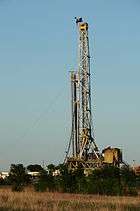
In the 19th century, natural gas was usually obtained as a byproduct of producing oil, since the small, light gas carbon chains came out of solution as the extracted fluids underwent pressure reduction from the reservoir to the surface, similar to uncapping a bottle of soda pop where the carbon dioxide effervesces. Unwanted natural gas was a disposal problem in the active oil fields. If there was not a market for natural gas near the wellhead it was virtually valueless since it had to be piped to the end user. In the 19th century and early 20th century, such unwanted gas usually was burned off in the oil fields. Today, unwanted gas (or 'stranded' gas without a market) associated with oil extraction often is returned to the reservoir with 'injection' wells while awaiting a possible future market or to repressurize the formation, which can enhance extraction rates from other wells. In regions with a high natural gas demand (such as the United States), pipelines are constructed when economics permit to take the gas from the wellsite to the end consumer.
Another solution is to export the natural gas as a liquid. Gas to liquids (GTL) is a developing technology that converts stranded natural gas into synthetic gasoline, diesel or jet fuel through the Fischer–Tropsch process developed in World War II Germany. Such fuel can be transported to users through conventional pipelines and tankers. Proponents claim GTL burns cleaner than comparable petroleum fuels. Most major international oil companies are in an advanced stage of GTL production, with a world-scale (140,000 barrels ({{#invoke:Math|precision_format| 22,258.22128992 | 1-4 }} m3) a day) GTL plant in Qatar scheduled to be in production before 2010.[dated info]
Natural gas can be "associated" (found in oil fields) or "non-associated" (isolated in natural gas fields), and is also found in coal beds (as coalbed methane). It sometimes contains significant amounts of ethane, propane, butane, and pentane—heavier hydrocarbons removed for commercial use prior to the methane being sold as a consumer fuel or chemical plant feedstock. Non-hydrocarbons such as carbon dioxide, nitrogen, helium (rarely), and hydrogen sulfide must be removed also before the natural gas can be transported.[3]
Natural gas is commercially extracted from oil fields and natural gas fields. Gas extracted from oil wells is called casinghead gas or associated gas. The natural gas industry is extracting gas from increasingly more challenging resource types: sour gas, tight gas, shale gas, and coalbed methane.
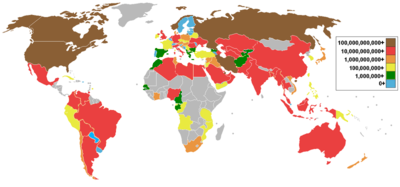
The world's largest proven gas reserves are located in Russia, with 4.757×10¹³ m³ (1.68×10¹⁵ cubic feet). With the Gazprom company, Russia is frequently the world's largest natural gas extractor. Major proven resources (in billion cubic meters) are world 175,400 (2006), Russia 47,570 (2006), Iran 26,370 (2006), Qatar 25,790 (2007), Saudi Arabia 6,568 (2006) and United Arab Emirates 5,823 (2006).
It is estimated that there are also about 900 trillion cubic meters of "unconventional" gas such as shale gas, of which 180 trillion may be recoverable.[4]In turn, many studies from MIT, Black & Veatch and the DOE -- see natural gas will account for a larger portion of electricity generation and heat in the future.[5]
The world's largest gas field is Qatar's offshore North Field, estimated to have 25 trillion cubic meters[6] (9.0×10¹⁴cubic feet) of gas in place—enough to last more than 420 years[citation needed] at optimum extraction levels. The second largest natural gas field is the South Pars Gas Field in Iranian waters in the Persian Gulf. Located next to Qatar's North Field, it has an estimated reserve of 8 to 14 trillion cubic meters[7] (2.8×10¹⁴ to 5.0×10¹⁴ cubic feet) of gas.
Because natural gas is not a pure product, as the reservoir pressure drops when non-associated gas is extracted from a field under supercritical (pressure/temperature) conditions, the higher molecular weight components may partially condense upon isothermic depressurizing—an effect called retrograde condensation. The liquid thus formed may get trapped as the pores of the gas reservoir get deposited. One method to deal with this problem is to re-inject dried gas free of condensate to maintain the underground pressure and to allow re-evaporation and extraction of condensates. More frequently, the liquid condenses at the surface, and this is one of the uses of the gas plant to collect this condensate. The resulting liquid is called natural gas liquid (NGL) and has a good commercial value.
Town gas
Town gas is a synthetically produced mixture of methane and other gases, mainly the highly toxic carbon monoxide, that can be used in a similar way to natural gas and can be produced by treating coal chemically. This is a historical technology, still used as 'best solution' in some local circumstances, although coal gasification is not usually economic at current gas prices. However, depending upon infrastructure considerations, it remains a future possibility.
Most town "gashouses" located in the eastern United States in the late 19th and early 20th centuries were simple by-product coke ovens which heated bituminous coal in air-tight chambers. The gas driven off from the coal was collected and distributed through town-wide networks of pipes to residences and other buildings where it was used for cooking and lighting purposes. (Gas heating did not come into widespread use until the last half of the 20th century.) The coal tar that collected in the bottoms of the gashouse ovens was often used for roofing and other water-proofing purposes, and also, when mixed with sand and gravel, was used for creating asphalt for the surfacing of local streets.
Biogas
When methane-rich gases are produced by the anaerobic decay of non-fossil organic matter (biomass), these are referred to as biogas (or natural biogas). Sources of biogas include swamps, marshes, and landfills (see landfill gas), as well as sewage sludge and manure[8] by way of anaerobic digesters, in addition to enteric fermentation particularly in cattle.
Methanogenic archaea are responsible for all biological sources of methane, some in symbiotic relationships with other life forms, including termites, ruminants, and cultivated crops. Methane released directly into the atmosphere would be considered a pollutant. However, methane in the atmosphere is oxidized, producing carbon dioxide and water. Methane in the atmosphere has a half life of seven years, meaning that if a tonne of methane were emitted today, 500 kilograms would have broken down to carbon dioxide and water after seven years.
Other sources of methane, the principal component of natural gas, include landfill gas, biogas and methane hydrate. Biogas, and especially landfill gas, are already used in some areas, but their use could be greatly expanded. Landfill gas is a type of biogas, but biogas usually refers to gas produced from organic material that has not been mixed with other waste.
Landfill gas is created from the decomposition of waste in landfills. If the gas is not removed, the pressure may get so high that it works its way to the surface, causing damage to the landfill structure, unpleasant odor, vegetation die-off and an explosion hazard. The gas can be vented to the atmosphere, flared or burned to produce electricity or heat. Experimental systems were being proposed for use in parts Hertfordshire, UK and Lyon in France.
Once water vapor is removed, about half of landfill gas is methane. Almost all of the rest is carbon dioxide, but there are also small amounts of nitrogen, oxygen and hydrogen. There are usually trace amounts of hydrogen sulfide and siloxanes, but their concentration varies widely. Landfill gas cannot be distributed through utility natural gas pipelines unless it is cleaned up to less than 3% CO2, and a few parts per million H2S, because CO2 and H2S corrode the pipelines.[9] It is usually more economical to combust the gas on site or within a short distance of the landfill using a dedicated pipeline. Water vapor is often removed, even if the gas is combusted on site. If low temperatures condense water out of the gas, siloxanes can be lowered as well because they tend to condense out with the water vapor. Other non-methane components may also be removed in order to meet emission standards, to prevent fouling of the equipment or for environmental considerations. Co-firing landfill gas with natural gas improves combustion, which lowers emissions.
Gas generated in sewage treatment plants is commonly used to generate electricity. For example, the Hyperion sewage plant in Los Angeles burns 8 million cubic feet of gas per day to generate power [10] New York City utilizes gas to run equipment in the sewage plants, to generate electricity, and in boilers.[11] Using sewage gas to make electricity is not limited to large cities. The city of Bakersfield, California uses cogeneration at its sewer plants.[12] California has 242 sewage wastewater treatment plants, 74 of which have installed anaerobic digesters. The total biopower generation from the 74 plants is about 66 MW.[13]
Biogas is usually produced using agricultural waste materials, such as otherwise unusable parts of plants and manure. Biogas can also be produced by separating organic materials from waste that otherwise goes to landfills. Such method is more efficient than just capturing the landfill gas it produces. Using materials that would otherwise generate no income, or even cost money to get rid of, improves the profitability and energy balance of biogas production.
Anaerobic lagoons produce biogas from manure, while biogas reactors can be used for manure or plant parts. Like landfill gas, biogas is mostly methane and carbon dioxide, with small amounts of nitrogen, oxygen and hydrogen. However, with the exception of pesticides, there are usually lower levels of contaminants.
Crystallized natural gas – hydrates
Huge quantities of natural gas (primarily methane) exist in the form of hydrates under sediment on offshore continental shelves and on land in arctic regions that experience permafrost such as those in Siberia (hydrates require a combination of high pressure and low temperature to form). However, as of 2010[update] no technology has been developed to extract natural gas economically from hydrates.
In 2010, using current technology, the cost of extracting natural gas from crystallized natural gas is estimated to 100%–200% the cost of extracting natural gas from conventional sources, and even higher from offshore deposits.[15]
Natural gas processing
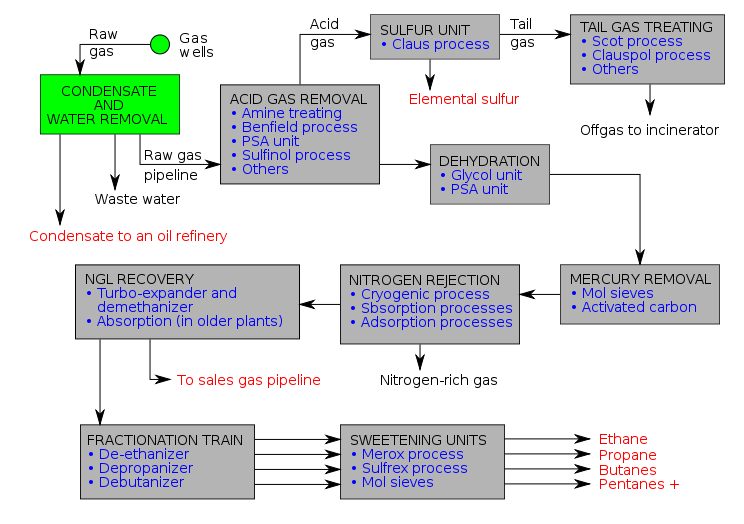
The image below is a schematic block flow diagram of a typical natural gas processing plant. It shows the various unit processes used to convert raw natural gas into sales gas pipelined to the end user markets.
The block flow diagram also shows how processing of the raw natural gas yields byproduct sulfur, byproduct ethane, and natural gas liquids (NGL) propane, butanes and natural gasoline (denoted as pentanes +).[16][17][18][19][20]
Uses
Power generation
Natural gas is a major source of electricity generation through the use of gas turbines and steam turbines. Most grid peaking power plants and some off-grid engine-generators use natural gas. Particularly high efficiencies can be achieved through combining gas turbines with a steam turbine in combined cycle mode. Natural gas burns more cleanly than other Hydrocarbon fuels, such as oil and coal, and produces less carbon dioxide per unit of energy released. For an equivalent amount of heat, burning natural gas produces about 30% less carbon dioxide than burning petroleum and about 45% less than burning coal.[21] Combined cycle power generation using natural gas is thus the cleanest source of power available using hydrocarbon fuels, and this technology is widely used wherever gas can be obtained at a reasonable cost. Fuel cell technology may eventually provide cleaner options for converting natural gas into electricity, but as yet it is not price-competitive.
Domestic use
 | The examples and perspective in this article deal primarily with the United States and do not represent a worldwide view of the subject. (December 2010) |
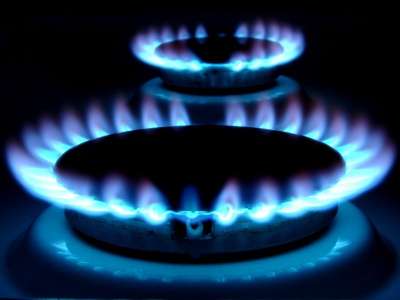
Natural gas dispensed from a simple stovetop can generate heat in excess of 2000°F (1093°C) making it a powerful domestic cooking and heating fuel.[22] In much of the developed world it is supplied to homes via pipes where it is used for many purposes including natural gas-powered ranges and ovens, natural gas-heated clothes dryers, heating/cooling and central heating. Home or other building heating may include boilers, furnaces, and water heaters. Compressed natural gas (CNG) is used in rural homes without connections to piped-in public utility services, or with portable grills. Natural gas is also supplied by independent natural gas suppliers through Natural Gas Choice programs throughout the United States. However, due to CNG being less economical than LPG, LPG (propane) is the dominant source of rural gas.

Transportation
CNG is a cleaner alternative to other automobile fuels such as gasoline (petrol) and diesel. As of 2008 there were 9.6 million natural gas vehicles worldwide, led by Pakistan (2.0 million), Argentina (1.7 million), Brazil (1.6 million), Iran (1.0 million), and India (650,000).[23][24] The energy efficiency is generally equal to that of gasoline engines, but lower compared with modern diesel engines. Gasoline/petrol vehicles converted to run on natural gas suffer because of the low compression ratio of their engines, resulting in a cropping of delivered power while running on natural gas (10%–15%). CNG-specific engines, however, use a higher compression ratio due to this fuel's higher octane number of 120–130.[25]
Fertilizers
Natural gas is a major feedstock for the production of ammonia, via the Haber process, for use in fertilizer production.
Aviation
Russian aircraft manufacturer Tupolev is currently running a development program to produce LNG- and hydrogen-powered aircraft.[26] The program has been running since the mid-1970s, and seeks to develop LNG and hydrogen variants of the Tu-204 and Tu-334 passenger aircraft, and also the Tu-330 cargo aircraft. It claims that at current market prices, an LNG-powered aircraft would cost 5,000 roubles (~ $218/ £112) less to operate per ton, roughly equivalent to 60%, with considerable reductions to [[carbon monoxide]], [[hydrocarbon]] and [[nitrogen oxide]] emissions. The advantages of liquid methane as a jet engine fuel are that it has more specific energy than the standard [[kerosene]] mixes do and that its low temperature can help cool the air which the engine compresses for greater volumetric efficiency, in effect replacing an [[intercooler]]. Alternatively, it can be used to lower the temperature of the exhaust. ===Hydrogen=== Natural gas can be used to produce [[hydrogen]], with one common method being the [[hydrogen reformer]]. Hydrogen has many applications: it is a primary feedstock for the chemical industry, a hydrogenating agent, an important commodity for oil refineries, and a fuel source in [[hydrogen vehicle]]s. ===Other=== Natural gas is also used in the manufacture of [[textile|fabric]]s, [[glass]], [[steel]], [[plastic]]s, [[paint]], and other products. ==Storage and transport== [[Image:Polyethylene gas main.jpg|thumb|upright|[[Polyethylene]] plastic [[Gas main|main]] being placed in a [[trench]].]] Because of its low density, it is not easy to store natural gas or transport by vehicle. Natural gas [[pipeline transport|pipelines]] are impractical across [[ocean]]s. Many [[List of natural gas pipelines#North America|existing pipelines in America]] are close to reaching their capacity, prompting some politicians representing northern states to speak of potential shortages. In [[Europe]], the gas pipeline network is already dense in the West.UNIQ480ce89d7bccdb41-nowiki-00000053-QINU27UNIQ480ce89d7bccdb41-nowiki-00000054-QINU New pipelines are planned or under construction in Eastern Europe and between gas fields in [[Russia]], [[Near East]] and [[Northern Africa]] and Western Europe. See also [[List of natural gas pipelines]]. [[LNG carrier]]s transport [[liquefied natural gas]] (LNG) across oceans, while [[tank truck]]s can carry liquefied or [[compressed natural gas]] (CNG) over shorter distances. Sea transport using [[CNG carrier]] ships that are now under development may be competitive with LNG transport in specific conditions. Gas is turned into liquid at a [[liquefaction of gases|liquefaction]] plant, and is returned to gas form at [[gasification|regasification]] plant at the [[LNG terminal|terminal]]. Shipborne regasification equipment is also used. LNG is the preferred form for long distance, high volume transportation of natural gas, whereas pipeline is preferred for transport for distances up to 4,000 km over land and approximately half that distance offshore. CNG is transported at high pressure, typically above 200 [[bar (unit)|bars]]. Compressors and decompression equipment are less capital intensive and may be economical in smaller unit sizes than liquefaction/regasification plants. Natural gas trucks and carriers may transport natural gas directly to end-users, or to distribution points such as pipelines. [[Image:Manlove gas storage facility crop.jpg|thumb|left|[[Peoples Gas]] Manlove Field [[natural gas storage]] area in [[Newcomb Township, Champaign County, Illinois]]. In the foreground (left) is one of the numerous wells for the underground storage area, with an LNG plant, and above ground storage tanks are in the background (right).]] In the past, the natural gas which was recovered in the course of recovering [[petroleum]] could not be profitably sold, and was simply burned at the oil field in a process known as [[gas flare|flaring]]. Flaring is now illegal in many countries.UNIQ480ce89d7bccdb41-nowiki-00000056-QINU28UNIQ480ce89d7bccdb41-nowiki-00000057-QINU Additionally, companies now recognize that gas may be sold to consumers in the form of LNG or CNG, or through other transportation methods. The gas is now re-[[Wiktionary:inject|inject]]ed into the formation for later recovery. The re-injection also assists oil pumping by keeping underground pressures higher. A "master gas system" was invented in [[Saudi Arabia]] in the late 1970s, ending any necessity for flaring. Satellite observation, however, shows that flaringUNIQ480ce89d7bccdb41-nowiki-00000059-QINU29UNIQ480ce89d7bccdb41-nowiki-0000005A-QINU and ventingUNIQ480ce89d7bccdb41-nowiki-0000005C-QINU30UNIQ480ce89d7bccdb41-nowiki-0000005D-QINU are still practiced in some gas-extracting countries. Natural gas is used to generate electricity and heat for [[desalination]]. Similarly, some landfills that also discharge methane gases have been set up to capture the methane and generate electricity. Natural gas is often stored underground inside depleted gas reservoirs from previous gas wells, [[salt domes]], or in tanks as [[liquefied natural gas]]. The gas is injected in a time of low demand and extracted when demand picks up. Storage nearby end users helps to meet volatile demands, but such storage may not always be practicable. With 15 countries accounting for 84% of the worldwide extraction, access to natural gas has become an important issue in international politics, and countries vie for control of pipelines.UNIQ480ce89d7bccdb41-nowiki-0000005F-QINU31UNIQ480ce89d7bccdb41-nowiki-00000060-QINU In the first decade of the 21st century, [[Gazprom]], the state-owned energy company in Russia, engaged in disputes with [[Ukraine]] and [[Belarus]] over the price of natural gas, which have created worries that gas deliveries to parts of Europe could be cut off for political reasons.UNIQ480ce89d7bccdb41-nowiki-00000062-QINU32UNIQ480ce89d7bccdb41-nowiki-00000063-QINU [[FLNG|Floating Liquefied Natural Gas (FLNG)]] is an innovative technology designed to enable the development of offshore gas resources that would otherwise remain untapped because due to environmental or economic factors it is nonviable to develop them via a land-based LNG operation. FLNG technology also provides a number of environmental and economic advantages: * Environmental – Because all processing is done at the gas field, there is no requirement for long pipelines to shore, compression units to pump the gas to shore, dredging and jetty construction, and onshore construction of an LNG processing plant, which significantly reduces the environmental footprint.UNIQ480ce89d7bccdb41-nowiki-00000065-QINU33UNIQ480ce89d7bccdb41-nowiki-00000066-QINU Avoiding construction also helps preserve marine and coastal environments. In addition, environmental disturbance will be minimised during decommissioning because the facility can easily be disconnected and removed before being refurbished and re-deployed elsewhere. * Economic – Where pumping gas to shore can be prohibitively expensive, FLNG makes development economically viable. As a result, it will open up new business opportunities for countries to develop offshore gas fields that would otherwise remain stranded, such as those offshore East Africa.UNIQ480ce89d7bccdb41-nowiki-00000068-QINU34UNIQ480ce89d7bccdb41-nowiki-00000069-QINU Many gas and oil companies are considering the economic and environmental benefits of [[FLNG|Floating Liquefied Natural Gas (FLNG)]]However, for the time being, the only FLNG facility now in development is being built by Shell,UNIQ480ce89d7bccdb41-nowiki-0000006B-QINU35UNIQ480ce89d7bccdb41-nowiki-0000006C-QINU due for completion in around 2017.UNIQ480ce89d7bccdb41-nowiki-0000006E-QINU36UNIQ480ce89d7bccdb41-nowiki-0000006F-QINU ==Environmental effects==
The price of natural gas varies greatly depending on location and type of consumer. In 2007, a price of $7 per 1,000 cubic feet ([[Category:Pages with bad rounding precision]]{{#invoke:Math|precision_format| 28.316846592 | 1-1 }} m3) was typical in the United States. The typical caloric value of natural gas is roughly 1,000 [[British thermal unit]]s (BTU) per cubic foot, depending on gas composition. This corresponds to around $7 per million BTU, or around $7 per [[gigajoule]]. In April 2008, the wholesale price was $10 per 1,000 cubic feet ({{#invoke:Math|precision_format| 28.316846592 | 1-1 }} m3) ($10/MMBTU).UNIQ480ce89d7bccdb41-nowiki-00000090-QINU45UNIQ480ce89d7bccdb41-nowiki-00000091-QINU The residential price varies from 50% to 300% more than the wholesale price. At the end of 2007, this was $12–$16 per 1,000 cu ft ([[Category:Pages with bad rounding precision]]{{#invoke:Math|precision_format| 28.316846592 | 1-1 }} m3).UNIQ480ce89d7bccdb41-nowiki-00000093-QINU46UNIQ480ce89d7bccdb41-nowiki-00000094-QINU Natural gas in the United States is traded as a [[futures contract]] on the [[New York Mercantile Exchange]]. Each contract is for 10,000 MMBTU (~10,550 [[gigajoule]]s), or 10 billion BTU. Thus, if the price of gas is $10 per million BTUs on the NYMEX, the contract is worth $100,000.
European Union
As one of the world's largest importers of natural gas, the EU is a major player on the international gas market.
Gas prices for end users vary greatly across the EU.[47] A single European energy market, one of the key objectives of the European Union, should level the prices of gas in all EU member states.
United States
In US units, one standard cubic foot of natural gas produces around 1,028 British thermal units (BTU). The actual heating value when the water formed does not condense is the net heat of combustion and can be as much as 10% less.[48]
In the United States, retail sales are often in units of therms (th); 1 therm = 100,000 BTU. Gas meters measure the volume of gas used, and this is converted to therms by multiplying the volume by the energy content of the gas used during that period, which varies slightly over time. Wholesale transactions are generally done in decatherms (Dth), or in thousand decatherms (MDth), or in million decatherms (MMDth). A million decatherms is roughly a billion cubic feet of natural gas. Gas sales to domestic consumers may be in units of 100 standard cubic feet (Ccf).
As of 2009, the Potential Gas Committee estimated that the United States has total future recoverable natural gas resources approximately 100 times greater than current annual consumption.[49]
Canada
Canada uses metric measure for internal trade of petrochemical products. Consequently, natural gas is sold by the Gigajoule, a measure approximately equal to 1/2 of a barrel (250lbs) of oil, or 1 million BTUs, or 1000 cu ft of gas, or 100cu metres of gas.
Elsewhere
In the rest of the world, Natural gas is sold in Gigajoule retail units. LNG (liquefied natural gas) and LPG (liquefied petroleum gas) are traded in metric tons or mmBTU as spot deliveries. Long term Natural gas distribution contracts are signed in cubic metres, and LNG contracts are in metric tonnes (1,000kg). The LNG and LPG is transported by specialized transport ships, as the gas is liquified at cryogenic temperatures. The specification of each LNG/LPG cargo will usually contain the energy content, but this information is in general not available to the public.
In the Russian Federation, Gazprom sold approximately 250 billion cubic metres of natural gas in 2008.
See also
References
- ↑ "composition of natural gas". Naturalgas.org. http://www.naturalgas.org/overview/background.asp. Retrieved 2011-02-06.
- ↑ US Geological Survey, Organic origins of petroleum,.
- ↑ "Natural gas overview". Naturalgas.org. http://www.naturalgas.org/overview/background.asp. Retrieved 2011-02-06.
- ↑ "Wonderfuel: Welcome to the age of unconventional gas" by Helen Knight, New Scientist, 12 June 2010, pp. 44–7.
- ↑ Michael Kanellos, Greentechmedia. “In Natural Gas, U.S. Will Move From Abundance to Imports.” June 9, 2011.
- ↑ "Background note: Qatar". State.gov. 2010-09-22. http://www.state.gov/r/pa/ei/bgn/5437.htm. Retrieved 2011-02-06.
- ↑ "Pars Special Economic Energy Zone". Pars Special Economic Energy Zone. http://www.pseez.ir/gas-en.html. Retrieved 2007-07-17.
- ↑ "Manure Management and Air Quality at the University of Minnesota". Manure.umn.edu. http://www.manure.umn.edu/. Retrieved 2011-02-06.
- ↑ "Interstate Natural Gas--Quality Specifications Interchangeability White Paper With Exhibits" (PDF). http://www.beg.utexas.edu/energyecon/lng/documents/CEE_Interstate_Natural_Gas_Quality_Specifications_and_Interchangeability.pdf. Retrieved 2011-02-06.
- ↑ "LA Sewers". LA Sewers. http://www.lasewers.org/treatment_plants/hyperion/index.htm. Retrieved 2011-02-06.
- ↑ "WastewaterInsides-05" (PDF). http://www.nyc.gov/html/dep/pdf/wwsystem.pdf. Retrieved 2011-02-06.
- ↑ "Bakersfield Wastewater Treatment Plant 3". Parsons.com. 2009-12-05. http://www.parsons.com/projects/Pages/bakersfield-wwtp-3.aspx. Retrieved 2011-02-06.
- ↑ http://www.energy.ca.gov/2010publications/CEC-500-2010-007/CEC-500-2010-007.PDF
- ↑ http://www.naturalgas.org/images/McMahon-Plnt.jpg on http://www.naturalgas.org/naturalgas/processing_ng.asp
- ↑ By Steve Hargreaves, staff writer (2010-03-09). "Fortune Magazine – Frozen Natural Gas in Indian Ocean". Money.cnn.com. http://money.cnn.com/2010/03/09/news/economy/nat_gas_crystals/index.htm. Retrieved 2011-02-06.
- ↑ "Natural Gas Processing: The Crucial Link Between Natural Gas Production and Its Transportation to Market" (PDF). http://www.eia.doe.gov/pub/oil_gas/natural_gas/feature_articles/2006/ngprocess/ngprocess.pdf. Retrieved 2011-02-06.
- ↑ "''Example Gas Plant''". Uop.com. http://www.uop.com/gasprocessing/6070.html. Retrieved 2011-02-06.
- ↑ "''From Purification to Liquefaction Gas Processing''" (PDF). http://www.axens.net/upload/presentations/fichier/axens_gpagcc_2004v2.pdf. Retrieved 2011-02-06.
- ↑ Feed-Gas Treatment Design for the Pearl GTL Project[dead link]
- ↑ Benefits of integrating NGL extraction and LNG liquefaction[dead link]
- ↑ 21.0 21.1 "Natural Gas and the Environment". Naturalgas.org. http://www.naturalgas.org/environment/naturalgas.asp#greenhouse/. Retrieved 2011-02-06.
- ↑ {{#invoke:citation/CS1|citation |CitationClass=book }}
- ↑ "Natural Gas Vehicle Statistics". International Association for Natural Gas Vehicles. http://www.iangv.org/tools-resources/statistics.html. Retrieved 2009-10-19.
- ↑ Pike Research (2009-10-19). "Forecast: 17M Natural Gas Vehicles Worldwide by 2015". Green Car Congress. http://www.greencarcongress.com/2009/10/forecast-17m-natural-gas-vehicles-worldwide-by-2015.html#more. Retrieved 2009-10-19.
- ↑ Clean Engine Vehicle[dead link], Measurement and Control Laboratory
- ↑ "PSC Tupolev – Development of Cryogenic Fuel Aircraft". Tupolev.ru. http://www.tupolev.ru/English/Show.asp?SectionID=82&Page=1. Retrieved 2011-02-06.
- ↑ Gas Infrasturcture Europe. Retrieved June 18. 2009.
- ↑ {{#invoke:citation/CS1|citation |CitationClass=book }}
- ↑ "Satellite observation of flares in the world". http://www.ethanzuckerman.com/blog/wp-content/2007/11/flares.jpg. Retrieved 2011-02-06.
- ↑ Satellite observation of methane in earth's atmosphere
- ↑ "The Contours of the New Cold War". Imi-online.de. http://www.imi-online.de/2007.php3?id=1589. Retrieved 2011-02-06.
- ↑ "Gazprom and Russian Foreign Policy". Npr.org. http://www.npr.org/templates/story/story.php?storyId=99026745. Retrieved 2011-02-06.
- ↑ http://www.seaaoc.com/news-old/shell-receives-green-light-for-prelude-flng
- ↑ http://www.visiongain.com/Report/568/The-Floating-Liquefied-Natural-Gas-(FLNG)-Market-2011-2021
- ↑ http://www.platts.com/weblog/oilblog/2011/03/31/shell_australia.html
- ↑ http://www.ft.com/cms/s/0/9ccaed4a-82ba-11e0-b97c-00144feabdc0.html#axzz1NADgzzOH
- ↑ http://www.ipcc.ch/ipccreports/ar4-wg3.htm
- ↑ "Curbing Emissions by Sealing Gas Leaks". nytimes.com. 2009-10-15. http://www.nytimes.com/2009/10/15/business/energy-environment/15degrees.html?_r=2&hpw. Retrieved 2011-02-06.
- ↑ "Wolfram Alpha query: "World Natural Gas Production"". Wolframalpha.com. http://www.wolframalpha.com/input/?i=world+natural+gas+production. Retrieved 2011-02-06.
- ↑ "US EPA: Climate Economics". Epa.gov. 2006-06-28. http://www.epa.gov/climatechange/economics/international.html. Retrieved 2011-02-06.
- ↑ http://www.nbr.org/downloads/pdfs/eta/PES_2011_Herberg.pdf Natural Gas in Asia: History and Prospects by Mikkal Herberg (written for 2011 Pacific Energy Summit
- ↑ ""Gas vs Coal"". Global-greenhouse-warming.com. http://www.global-greenhouse-warming.com/gas-vs-coal.html. Retrieved 2011-02-06.
- ↑ "''Fundamentals of Physical Geography (2nd Edition)'', "Chapter 7: Introduction to the Atmosphere," (h). "The Greenhouse Effect"". Physicalgeography.net. http://www.physicalgeography.net/fundamentals/7h.html. Retrieved 2011-02-06.
- ↑ "Processing Natural Gas". NaturalGas.org. http://www.naturalgas.org/naturalgas/processing_ng.asp. Retrieved 2011-02-06.
- ↑ James L. Williams (1998-10-02). "Graph of Natural Gas Futures Prices – NYMEX". Wtrg.com. http://www.wtrg.com/daily/gasprice.html. Retrieved 2011-02-06.
- ↑ "Natural Gas Prices published by the US government". Tonto.eia.doe.gov. http://tonto.eia.doe.gov/dnav/ng/ng_pri_sum_dcu_nus_m.htm. Retrieved 2011-02-06.
- ↑ EU Gas Prices
- ↑ Heat value definitions. WSU website. Retrieved 2008-05-19.
- ↑ Potential Gas Committee, Potential Gas Committee reports unprecedented increase in magnitude of U.S. natural gas resource base, 18 June 2009. Retrieved 2011-06-25.
- All articles with dead external links
- Articles with dead external links from February 2011
- Articles with invalid date parameter in template
- Pages with bad rounding precision
- Wikipedia articles in need of updating from January 2010
- All articles with unsourced statements
- Articles with unsourced statements from January 2011
- Pages with broken file links
- Articles containing potentially dated statements from 2010
- All articles containing potentially dated statements
- Articles with limited geographic scope from December 2010
- Pages in non-existent country centric categories
- Natural gas
- Fuel gas